Swim Paddles Manufacturer Guide to Choosing the Best Pair for Your Training
2026-10-16
Choosing the right swim paddles can make or break your training—yet most swimmers settle for whatever is on sale. What if the secret to better technique and stronger pulls isn't just about size or shape, but the manufacturer behind the gear? OCORT has spent years refining paddle designs to match real training needs, not just marketing checklists. In this guide, we break down what separates a forgettable pair from the one you'll reach for every session. Get ready to rethink how you buy paddles.
Why Paddle Size Is More Personal Than Your Shoe Size
Shoe size follows a number you've known since middle school—your foot either fits a 9 or it doesn't. Paddle size, though, has no such certainty. A 16-inch paddle might feel like a wand in one player's hand and a broomstick in another's. The difference comes down to how your wrist hinges, how long your arms are, and even how you hold your coffee cup. That's why asking for the 'right' paddle size is like asking which pair of jeans should feel like a second skin: only your own body can answer that.
Think about what happens at the net. A longer paddle gives you extra reach for those desperation stabs, but it also shifts the balance point farther from your hand, making quick resets feel sluggish. A wider face offers a larger sweet spot, which forgives off-center hits, yet it can slow down your hand speed because of the extra wind resistance. Your grip size plays an even sneakier role—too small and you'll over-grip, causing tennis elbow; too large and your fingers can't wrap around the handle for controlled flicks. What works for a 6'4" former tennis player won't match a 5'2" pickleball convert who relies on touch and placement.
In the end, paddle size is less about a chart and more about conversation between you, the ball, and the court. Borrow a friend's oversized paddle for a game and you might hate it; switch to a compact shape and suddenly your third-shot drops feel automatic. That's the beauty: unlike shoes, which break in and conform to your feet, paddles wait for you to adapt to them. So don't chase the spec sheet—chase the feeling of the paddle disappearing in your hand when you play.
The Material Matters More Than Durability Alone
When choosing everyday gear, it's easy to fixate on how long something will last under stress. But the feel, weight, and even the way a material responds to your touch often shape the experience far more than a rugged spec sheet suggests. A jacket that survives a decade but feels like cardboard against your skin hardly earns a place in your rotation, while a softer, more responsive fabric might win you over within minutes of wear.
Of course, durability still matters, but it shouldn't overshadow the subtle qualities that define daily comfort. Materials with natural give, breathability, and a tactile warmth tend to be reached for again and again, even if they require a bit more care. The goal isn't simply to outlast the elements—it's to make the hours in between feel less like a compromise and more like a quiet pleasure.
In the end, the best material is the one you forget you're wearing. It moves when you move, adapts to your habits, and never fights back. Chasing pure toughness alone can leave you with gear that's impressive on paper but never truly yours. A well-chosen fabric, by contrast, becomes part of your daily rhythm, proving that how it feels matters just as much as how long it holds up.
How Strap Design Affects Stroke Mechanics
A strap that sits too high on the wrist quietly forces the joint into extension. You won't notice it on the first few strokes, but by the middle of a session the elbow starts dropping and the catch shortens. Moving the strap closer to the base of the palm keeps the wrist in a more neutral line with the forearm, which lets the fingers do the fine control instead of fighting the strap for position.
Tension matters just as much as placement. An overly tight strap turns the hand into a fixed lever, so the wrist can't absorb small pressure changes during the pull. That stiffness usually shows up as a rushed finish or a sudden flip at the release. A slightly looser fit, with just enough slack to slide one finger underneath, gives the hand room to make micro-adjustments without losing the connection to the paddle or handle.
Strap width and edge finishing also shape the stroke over time. Thin, unpadded straps concentrate pressure across a narrow line, and the body's natural response is to alter the recovery path to avoid that pinch. That compensation can flatten the forearm angle on the next entry. A wider strap or one with rounded edges spreads the load more evenly, so the hand stays relaxed through the full cycle and the mechanics stay repeatable.
Matching Resistance to Your Training Phase
In the early weeks of a training block, resistance should be light enough to reinforce movement patterns without burying technique under load. This isn't about chasing soreness; it's about building a foundation that lets heavier phases work later. Use tempo and pauses rather than raw weight to create tension.
As you move into strength or power phases, the resistance needs to climb, but not every lift should be maxed. Main lifts can sit in the 80–90% range for low reps while accessories stay moderate. The goal is to express force quickly or grind through heavy reps without turning every session into a test.
During maintenance or deload phases, resistance drops intentionally. You're not detraining; you're letting connective tissue recover while keeping neural patterns sharp. A good rule: enough load to feel the movement, not enough to disrupt the next block.
What Hand Shape and Finger Coverage Reveal About Fit
A glove that mirrors the natural curves of your hand does more than just cover skin; it becomes a second layer that moves with every flex and grip. When the palm width aligns with the webbing between your fingers, there's no excess fabric bunching at the base of the thumb, and your fingertips reach the ends without pressing hard against the seams. This balanced coverage lets you close your hand fully without the material pulling across the knuckles or sliding down toward the wrist.
Finger length plays a quiet but critical role. If the glove's fingers run even a few millimeters short, each bend creates tension at the tips, while overly long fingers force you to compensate by gripping harder or adjusting constantly. The sweet spot is when the glove ends just before your natural fingertip pads, leaving enough room for tactile feedback yet keeping the entire finger protected. Pay attention to how the little finger sits—it's often the first place a poor fit reveals itself, either riding up or twisting sideways.
Coverage across the back of the hand tells you whether the pattern was cut for a real human shape or just a generic oval. A well-designed glove will have a slight dome over the knuckles and a gentle taper toward the cuff, so when you make a fist, the material stretches evenly rather than forming deep folds. If you see diagonal wrinkles running from the index finger to the wrist, the hand shape doesn't match yours, and no amount of breaking in will fix that mismatch.
Signs You’re Using the Wrong Paddles and How to Fix It
Persistent wrist or hand pain after a short time on the water is a classic red flag. Often this comes from gripping a shaft that is too thick or too thin for your hand size, forcing your fingers into an unnatural position. Swap out the shaft for one with a diameter that lets your fingers wrap comfortably without straining, and consider adding grip tape to fine-tune the feel.
If you find yourself fighting to keep the boat tracking straight, the blade angle might be off for your stroke style. A paddle with a fixed feather angle that doesn’t match your natural wrist rotation will make every stroke feel awkward. Try a paddle with an adjustable ferrule so you can dial in a feather that keeps your wrists neutral, and notice how much less shoulder fatigue you feel.
Sometimes the issue is blade size or material. Blades that are too large will overload your muscles quickly, while overly stiff blades can jar your joints in rough water. Consider a smaller blade area for high-cadence paddling or a more flexible shaft for choppy conditions. A quick test on flat water with a different paddle can reveal whether a change in blade design solves your discomfort.
FAQ
Many oversized paddles add surface area but ruin your catch by forcing the hand to slip outward. A better design keeps the blade just slightly larger than the hand and concentrates surface near the fingers, not the wrist.
Both, but start with hand length. If the blade extends more than about an inch beyond your fingertips, it loads the shoulder too much. Then adjust stiffness or surface area down if you cannot hold a clean high-elbow catch for 400 meters.
Look for straps that wrap only around the middle finger or wrist rather than all four fingers. Full-finger loops force the hand to stay flat and delay the release, which can hide a weak finish.
Polypropylene or a stiff nylon blend works better than soft silicone. Softer materials flex during the pull and reduce feedback from the water. That feedback is exactly what builds your catch awareness.
Removing the wrist strap forces you to keep pressure on the water with your palm instead of leaning on the strap. It also lets the paddle fall away naturally if your stroke collapses, so you get immediate correction.
Yes, but only if they are not too large. Oversized paddles slow your turnover and encourage a long glide. A slightly smaller blade keeps stroke rate closer to race pace, which transfers better to normal swimming.
They chase a shape that feels powerful in the first 50 meters. The real test is whether the paddle stays quiet through the water after 800 meters. Noise and wobble usually mean the leading edge is too thick or the holes are placed for looks.
Holes reduce resistance and allow water to flow through, which is kinder to the shoulders during drill sets. Solid blades give stronger pressure but can mask a dropped elbow. For most swimmers, holes in the upper half are the safer default.
Conclusion
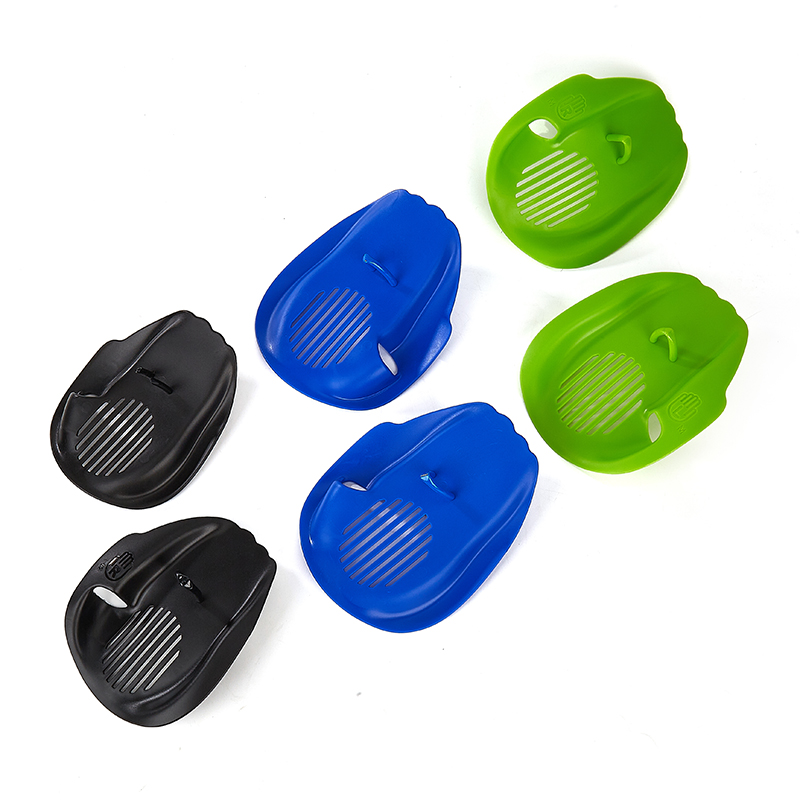
Choosing swim paddles isn't a one-size-fits-all exercise; in fact, your shoe size is a far less reliable starting point than the shape of your hand and how you naturally pull through the water. A paddle that's too large will overload your shoulders before your lats ever engage, while one that's too small can leave you wondering why you bothered strapping anything on at all. Material choice goes well beyond simple durability—softer plastics flex with your catch and forgive a sloppy entry, whereas rigid composites demand a cleaner stroke and give you immediate feedback when your wrist bends or your fingers separate. The strap system is equally personal: a tight single loop over the middle finger changes the way your hand tracks, while a looser wrist-and-finger setup allows more natural finger spread and a softer catch. Spend a few sessions experimenting with different sizes and strap tensions before committing.
Your training phase matters just as much as your anatomy. During early base phases, a slightly smaller paddle with moderate resistance lets you hold technique over long repeats, while heavier or larger paddles are better saved for short power blocks when you're already fresh and focused. Watch for warning signs that you've chosen poorly: shoulder ache after a few hundred meters, a feeling that you're fighting the water instead of anchoring into it, or slippage at the catch that forces you to overkick. Hand shape and finger coverage reveal a lot—paddles that cover only the palm leave your fingers free to feel the water, which is great for stroke awareness, while full-hand designs add surface area but demand more wrist stability. If something feels off, don't just push through. Swap sizes mid-set, adjust the straps, or switch to a different material until the paddle disappears from your mind and the water does the coaching.
Contact Us
Contact Person: Wendy
Email: [email protected]
Tel/WhatsApp: 86 18807398467
Website: https://www.zlfswim.com