
How Does Climbing Shoes Rubber Thickness Affect Performance?
2026-10-12
A customer walks into our shop and says they need a new pair of Climbing Shoes. They climb three times a week at the local bouldering gym. They tried their friend's shoes on a outdoor sport route last weekend and hated them. The shoes felt too stiff, and they could not feel the rock. The friend's shoes have a 5 mm rubber sole. The customer's current gym shoes have a 3.5 mm sole. The difference in thickness is 1.5 mm, but the difference in feel is dramatic. This guide explains how rubber thickness affects performance and how to match the thickness to the climbing style.
1. How Does Rubber Thickness Affect Sensitivity and Feedback?
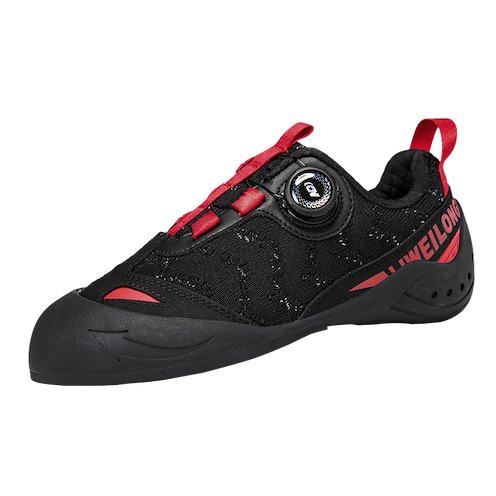
Sensitivity is the ability to feel the shape and texture of the rock through the sole of the Climbing Shoes. A thinner sole transmits more tactile information to the foot. This allows the climber to sense small edges, dimples, and friction surfaces. A thicker sole absorbs the vibrations and reduces the feedback. The relationship between thickness and sensitivity is not linear. A 1 mm reduction in thickness from 4 mm to 3 mm produces a noticeable improvement in sensitivity. A further reduction from 3 mm to 2 mm produces an even greater improvement, but at the cost of support and durability. The table below shows the sensitivity rating for different rubber thicknesses.
| Rubber thickness (mm) | Sensitivity rating (1-10) | Support rating (1-10) | Typical application |
| 2.0 – 2.5 | 9 – 10 | 3 – 4 | Competition bouldering |
| 3.0 – 3.5 | 7 – 8 | 5 – 6 | Gym bouldering, sport climbing |
| 4.0 – 4.5 | 5 – 6 | 7 – 8 | All-day trad, crack climbing |
| 5.0 – 5.5 | 3 – 4 | 9 – 10 | Multi-pitch, edging on small holds |
In our factory, we produce Climbing Shoes with rubber thicknesses from 2.0 mm to 5.5 mm. The rubber compound is also important. A softer rubber compound (lower durometer) provides better friction but wears faster. A harder compound lasts longer but provides less friction. The thickness and the compound must be matched to the climbing style. Xiamen Biyate Imp.&Exp.Co.,Ltd has been manufacturing climbing shoes for over 10 years.
2. How Does Thickness Affect Edging and Support?
Edging is the ability to stand on a small hold with the inside edge of the shoe. A thicker sole provides more support and reduces the deformation of the shoe under the climber's weight. This allows the climber to put more force on a small edge without the shoe rolling off. A thinner sole deforms more, which can cause the shoe to slip off the edge. The table below shows the edging performance for different thicknesses.
| Rubber thickness (mm) | Edging performance (1-10) | Force transmission efficiency | Typical hold size |
| 2.0 – 2.5 | 4 – 5 | 70 – 75% | > 10 mm |
| 3.0 – 3.5 | 6 – 7 | 80 – 85% | 5 – 10 mm |
| 4.0 – 4.5 | 8 – 9 | 88 – 92% | 2 – 5 mm |
| 5.0 – 5.5 | 9 – 10 | 93 – 96% | < 2 mm |
The force transmission efficiency is the percentage of the climber's force that is transferred to the hold. A thicker sole reduces the energy loss in the shoe. For trad climbing and multi-pitch routes where the climber must stand on small edges for long periods, a thicker sole is preferred. For bouldering where the climber needs to feel the rock and generate dynamic movement, a thinner sole is preferred.
3. How Does Thickness Affect Durability and Wear?
The durability of the Climbing Shoes is determined by the thickness of the rubber and the abrasion resistance of the compound. A thicker sole takes longer to wear through. A 5 mm sole will last 2 to 3 times longer than a 3 mm sole under the same conditions. The wear rate also depends on the climbing style. A climber who drags their toes on the wall will wear through the rubber faster than a climber who places their feet precisely. The table below shows the typical lifespan for different thicknesses.
| Rubber thickness (mm) | Typical lifespan (months) | Wear rate (mm per 100 hours) | Resole frequency |
| 2.0 – 2.5 | 4 – 6 | 0.8 – 1.2 | Every 3 – 4 months |
| 3.0 – 3.5 | 6 – 9 | 0.5 – 0.8 | Every 6 – 8 months |
| 4.0 – 4.5 | 10 – 14 | 0.3 – 0.5 | Every 12 – 18 months |
| 5.0 – 5.5 | 15 – 24 | 0.2 – 0.3 | Every 24 – 36 months |
Shop tip: When a customer asks about resoling, check the thickness of the remaining rubber. If the rubber is less than 1 mm thick at the toe, the shoe should be resoled before the rand is damaged. If the rand is damaged, the repair is more expensive. We recommend that customers keep a spare pair of Climbing Shoes and rotate them to extend the life of both pairs.
4. How Should the Thickness Be Matched to the Climbing Style?
The selection of rubber thickness should be based on the primary climbing style. For competition bouldering, a thin sole (2.0 to 2.5 mm) provides maximum sensitivity and friction. For gym bouldering and sport climbing, a medium sole (3.0 to 3.5 mm) provides a balance of sensitivity and support. For trad climbing and crack climbing, a thicker sole (4.0 to 4.5 mm) provides support and durability. For multi-pitch and alpine climbing, the thickest sole (5.0 to 5.5 mm) provides maximum support and protection. The table below provides a selection guide.
| Climbing style | Recommended thickness | Key requirement | Example shoe type |
| Competition bouldering | 2.0 – 2.5 mm | Maximum sensitivity | Downturned, soft |
| Gym bouldering | 3.0 – 3.5 mm | Balance of sensitivity and support | Moderate downturn |
| Sport climbing | 3.0 – 4.0 mm | Edging and sensitivity | Moderate downturn |
| Trad climbing | 4.0 – 4.5 mm | Support and durability | Flat, stiff |
| Multi-pitch / alpine | 5.0 – 5.5 mm | Maximum support and protection | Flat, very stiff |
In our factory, we produce Climbing Shoes for all of these styles. We also offer custom rubber thickness options for brands that want to differentiate their product line. Biyate provides technical support to help brands select the right thickness for their target market.
Frequently Asked Questions About Climbing Shoes Rubber Thickness
Summary for Gear Shop Staff and Climbers
Rubber thickness in Climbing Shoes is a trade-off between sensitivity, support, and durability. A thin sole (2.0 to 2.5 mm) provides maximum sensitivity for competition bouldering. A medium sole (3.0 to 3.5 mm) provides a balance for gym and sport climbing. A thick sole (4.0 to 5.5 mm) provides support and durability for trad and multi-pitch climbing. The right thickness depends on the climbing style and the rock type. Our factory produces climbing shoes with a full range of rubber thicknesses and can advise on the best choice for your target market. Xiamen Biyate Imp.&Exp.Co.,Ltd has been manufacturing climbing shoes for over 10 years.
Xiamen Biyate Imp.&Exp.Co.,Ltd manufactures Climbing Shoes with rubber thicknesses from 2.0 mm to 5.5 mm, in a range of compounds and last shapes. We provide technical support and custom manufacturing for brands worldwide.