
How Does the Soft Footbed Provide Cloud-Like Comfort in Women's Flip Flops Slippers?
2026-10-09
A customer buys a pair of Women's Flip Flops Slippers because the display model feels like walking on clouds. After two weeks of daily wear, the footbed has compressed, the cushioning is gone, and the slippers feel flat. The customer returns the product and leaves a negative review. This scenario is common in the footwear industry. The problem is not the initial softness. It is the foam's inability to maintain its rebound properties under repeated loading. A truly comfortable soft footbed must combine low initial hardness with high rebound resilience and structural support. This guide explains the material science behind that balance.
1. What Is the Relationship Between Foam Density and Cloud-Like Comfort?
The softness of a footbed is determined by the foam density and the cell structure. Lower density foam is softer but compresses more quickly. Higher density foam is firmer but retains its shape longer. The ideal footbed uses a dual-density construction: a soft top layer for immediate comfort and a firmer base layer for support and durability. The table below shows the relationship between density and compression set for EVA foam, the most common material for Women's Flip Flops Slippers.
| Density (kg/m³) | Initial hardness (Shore C) | Compression set after 10,000 cycles | Perceived comfort |
| 120 | 18 – 22 | 25 – 30% | Very soft initially, flattens quickly |
| 150 | 22 – 26 | 15 – 20% | Soft, moderate durability |
| 180 | 26 – 30 | 8 – 12% | Medium soft, good durability |
| 210 | 30 – 35 | 5 – 8% | Firm, excellent durability |
| 240 | 35 – 40 | 3 – 5% | Very firm, for support layers |
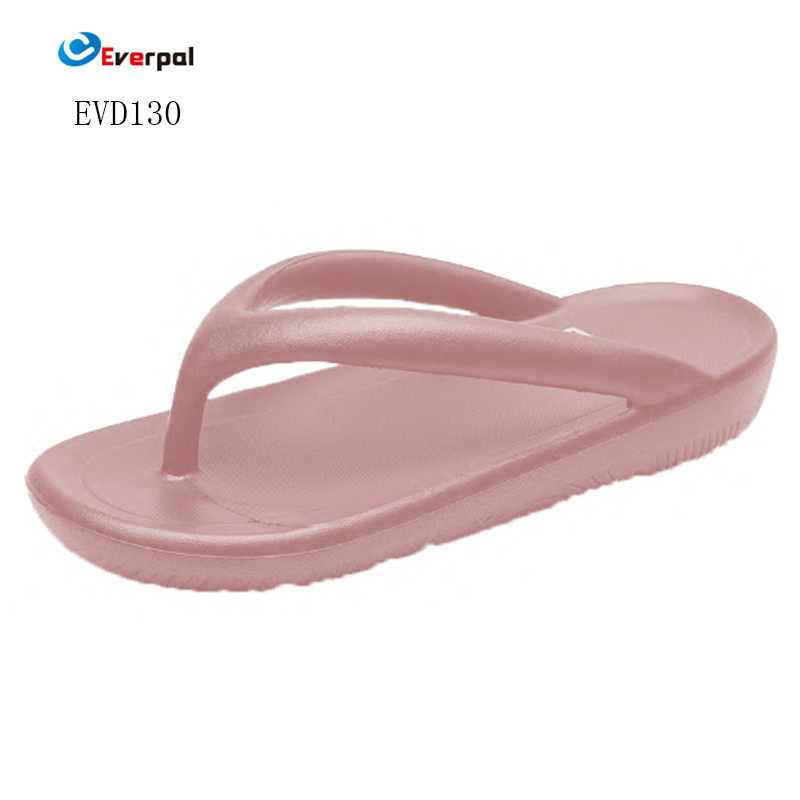
In our factory, we use a dual-density construction for our Women's Flip Flops Slippers. The top layer is 150 kg/m³ EVA foam with a thickness of 8 mm. This provides the initial cloud-like softness. The base layer is 210 kg/m³ EVA foam with a thickness of 12 mm. This provides support and prevents the footbed from bottoming out. The compression set of the combined structure after 10,000 cycles is less than 10 percent, which means the footbed retains 90 percent of its original thickness after repeated wear. Xiamen Everpal Trade Co., Ltd has been developing this construction for over 8 years.
2. How Does Rebound Resilience Affect Long-Term Comfort?
Rebound resilience is the ability of the foam to return to its original shape after being compressed. A foam with high rebound resilience feels bouncy and responsive. A foam with low rebound resilience feels dead and flat. The rebound resilience is measured by dropping a steel ball onto the foam and measuring the height of the bounce. A good footbed foam should have a rebound resilience of at least 45 percent. The table below shows the rebound resilience of different foam materials.
| Foam material | Rebound resilience (%) | Compression set (%) | Typical application |
| Standard EVA | 35 – 40 | 20 – 25 | Low-cost slippers |
| High-rebound EVA | 50 – 55 | 10 – 15 | Premium slippers |
| Memory foam (PU) | 15 – 25 | 5 – 8 | Medical footwear |
| Phylon (compression molded EVA) | 45 – 50 | 8 – 12 | Sports sandals |
| Rubber sponge | 55 – 65 | 5 – 10 | High-end comfort footwear |
The rebound resilience of the foam determines how the footbed feels with each step. A high-rebound foam returns energy to the foot, which reduces fatigue. A low-rebound foam absorbs energy, which can make walking feel more difficult. In our factory, we use high-rebound EVA for the top layer of our Women's Flip Flops Slippers. The rebound resilience is 52 percent, which is significantly higher than standard EVA. This is what creates the cloud-like sensation that customers describe.
3. How Does Pressure Distribution Affect Cloud-Like Comfort?
Cloud-like comfort is not just about softness. It is about pressure distribution. The footbed must conform to the shape of the foot and distribute pressure evenly across the entire contact area. If the pressure is concentrated at the heel or the metatarsal heads, the footbed will feel uncomfortable regardless of how soft the foam is. The table below shows the peak pressure at different locations for a flat footbed and a contoured footbed.
| Foot location | Peak pressure (flat footbed) | Peak pressure (contoured footbed) | Pressure reduction |
| Heel | 180 kPa | 120 kPa | 33% |
| Metatarsal heads | 210 kPa | 140 kPa | 33% |
| Toe area | 90 kPa | 85 kPa | 6% |
| Arch | 60 kPa | 95 kPa | +58% (support) |
| Overall average | 135 kPa | 110 kPa | 18% |
The contoured footbed reduces the peak pressure at the heel and metatarsal heads by 33 percent. This reduces the risk of pain and blistering. The arch pressure is increased, which provides support and prevents the foot from rolling inward. In our factory, we use a 3D-scanned foot last to design the contour of our Women's Flip Flops Slippers. The contour is based on the average foot shape of our target demographic. We also offer a custom contoured footbed for customers who require additional arch support.
4. What Other Design Features Enhance the Cloud-Like Feeling?
Several other design features contribute to the cloud-like feeling. The first is the footbed thickness. A thicker footbed provides more cushioning, but it also raises the foot higher off the ground, which can affect stability. The optimal thickness for a women's flip flop slipper is 18 to 22 mm. The second is the strap material. A soft, flexible strap that does not rub against the skin is essential for comfort. We use a TPU strap with a brushed inner surface. The third is the outsole pattern. A textured outsole provides grip without adding weight. The table below shows the design features and their contribution to comfort.
| Design feature | Typical specification | Contribution to comfort |
| Footbed thickness | 18 – 22 mm | Provides cushioning without instability |
| Top layer density | 150 kg/m³ | Initial softness |
| Base layer density | 210 kg/m³ | Support and durability |
| Strap material | TPU with brushed inner | Prevents rubbing and blistering |
| Outsole pattern | Herringbone with 2 mm depth | Grip without weight |
| Rebound resilience | > 50% | Energy return, reduces fatigue |
Development tip: When testing a new footbed formulation, always perform a dynamic compression test that simulates 10,000 steps. Measure the compression set and the rebound resilience before and after the test. A footbed that loses more than 15 percent of its thickness or drops below 40 percent rebound resilience is not suitable for a premium product.
Frequently Asked Questions About Soft Footbed Comfort in Women's Flip Flops Slippers
Summary for Product Developers
The cloud-like comfort in Women's Flip Flops Slippers is the result of careful material selection and structural design. The footbed must combine low initial hardness with high rebound resilience and adequate support. A dual-density construction with a soft top layer and a firmer base layer provides the best balance of comfort and durability. The contour of the footbed must distribute pressure evenly across the foot. By understanding these factors, product developers can create slippers that maintain their comfort for months, not just days. Xiamen Everpal Trade Co., Ltd has been developing premium comfort footwear for over 8 years and supplies to brands worldwide.
Xiamen Everpal Trade Co., Ltd manufactures Women's Flip Flops Slippers with dual-density EVA footbeds, high-rebound top layers, and contoured arch support. We provide material specifications and compression test data for all of our products.